
Three different operations
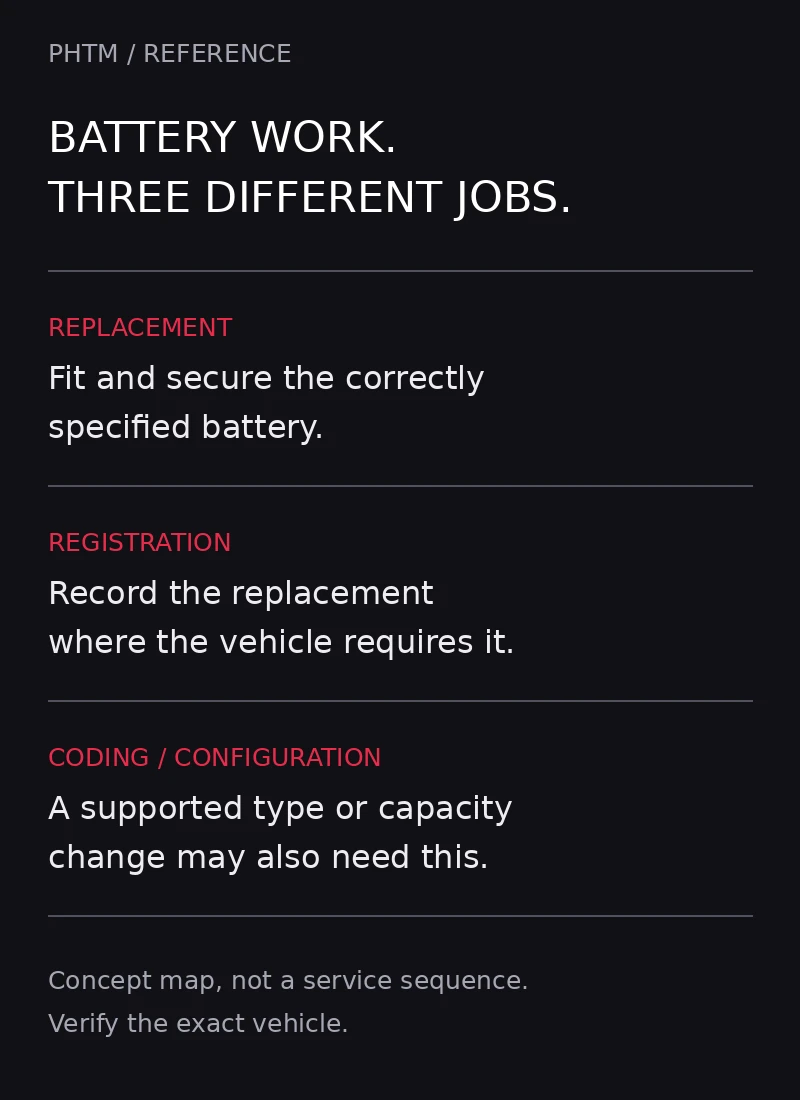
Coding / configuration
Where a supported replacement changes the configured type or capacity, the vehicle must also be set up for that specification. BimmerCode’s F30 documentation explicitly distinguishes battery type/capacity coding from subsequent registration. Do not assume that selecting “register” changes every required setting.
Sources 6
What the IBS does
The Intelligent Battery Sensor measures battery voltage, current and temperature. The energy-management system uses these inputs to assess charge and condition and manage electrical energy. This is why a battery is not simply an isolated box supplying a fixed voltage.
A battery warning is not proof that the IBS is faulty. Diagnosis should identify whether the battery, charging system, connection or electrical demand is responsible.
Sources 3
AGM, flooded and EFB are not interchangeable labels
AGM means absorbent glass mat: the electrolyte is held in glass-fiber material. EFB is an enhanced flooded lead-acid design. Their cycling and charging requirements differ from a conventional starter battery.
Use the chemistry and capacity approved for the vehicle. Do not downgrade an AGM application to a conventional flooded battery because it is cheaper or physically fits. Nor does a diagnostic menu listing a capacity establish that your car supports that upgrade.
Why model and production date matter
BMW bulletin SI B61 30 14 is a useful historical example: it gives different replacement paths for specific engines, chassis and build dates, including same-capacity registration versus a supported capacity change with additional programming. It also identifies fitment limits.
That bulletin is not permission to fit its recommended battery to every BMW today. Confirm the current repair instructions and replacement application for your VIN. Older or differently equipped cars may have a different battery-management process; hybrid, electric and multi-battery systems need their own instructions.
A practical replacement checklist
Before buying: identify the current battery label, the vehicle’s configured specification and the approved replacement. Resolve any mismatch rather than copying an old, possibly incorrect installation.
Before disconnecting: obtain the vehicle’s shutdown, disconnection, reconnection and post-replacement instructions. Confirm that your diagnostic tool supports this exact vehicle and service function.
After fitting: perform the required configuration and registration, then check that the tool confirms completion and the vehicle’s remaining faults are diagnosed. Keep the replacement record.
What if it is not registered correctly?
The car may continue applying assumptions that do not match the replacement battery. Incorrect management or chemistry can impair charging, shorten battery life or affect start-stop and comfort functions. The outcome is not identical on every car, and immediate starting does not prove the replacement is configured correctly.
Same capacity and type—still register it?
If the vehicle requires registration, yes. BMW’s reviewed bulletin includes a same-capacity registration path. A matching label is not a reason to skip the service function.
Sources 1
Can registration fix a battery that keeps going flat?
No. Record the replacement correctly, but diagnose repeated discharge and charging faults separately.
Sources 3
Sources / references 8
- BMW — SI B61 30 14, December 2015 revision, pages 4–5 ↗Reviewed Sep 27, 2026
- BMW USA — Digital owner’s manuals ↗Reviewed Sep 27, 2026
- HELLA — Checking an alternator regulator, IBS and battery-change sections ↗Reviewed Sep 27, 2026
- VARTA — Battery replacement and battery management ↗Reviewed Sep 27, 2026
- VARTA — EFB and AGM differences ↗Reviewed Sep 27, 2026
- BimmerCode — F30 supported functions, Battery type ↗Reviewed Sep 27, 2026
- BimmerLink — Battery registration ↗Reviewed Sep 27, 2026
- VARTA — Battery replacement ↗Reviewed Sep 27, 2026
Questions about this guide?
Share your vehicle details and what you have tried. Community posts are moderated; technical answers require verification.
Related discussions → · Ask a question →