
What the symptom tells you
Steering wheel shakes: tell the technician exactly where you feel it. The front wheel, brake and steering system deserves attention, but vibration can travel through the chassis.
Body or seat shakes: record this separately from steering-wheel movement. It does not, by itself, identify a rear brake fault. Have the whole vehicle assessed rather than ordering rear rotors from that clue alone.
Sources 2
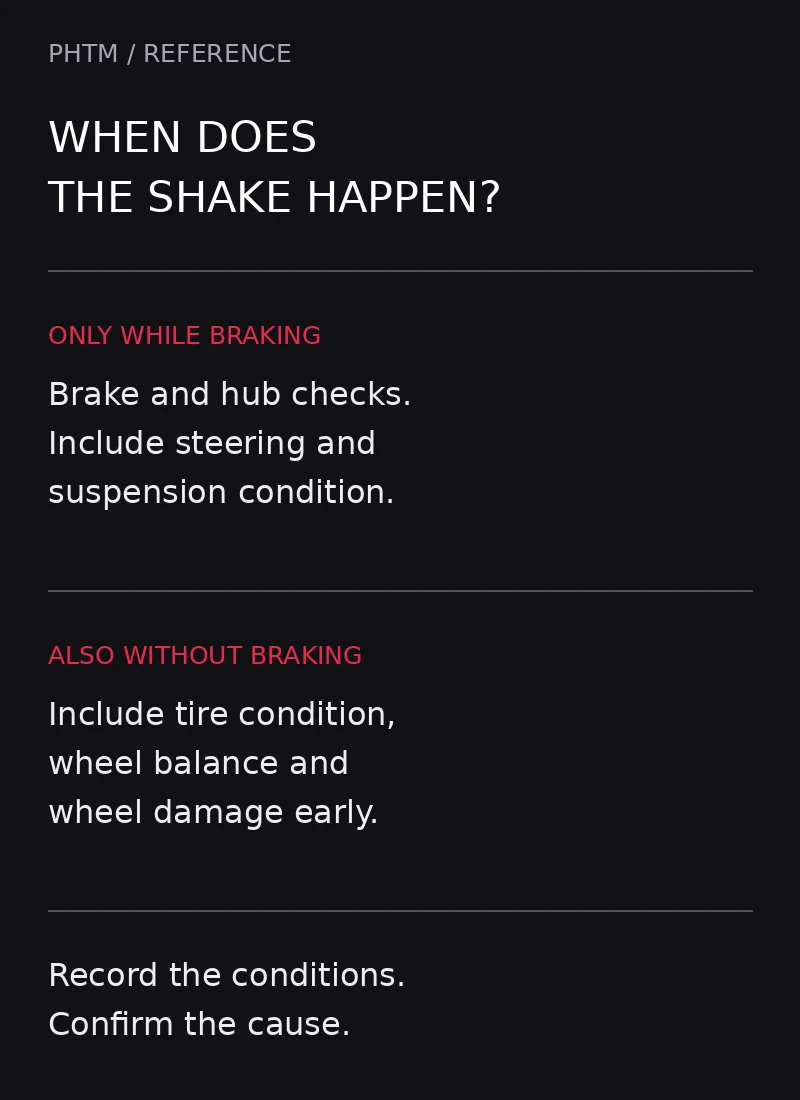
Only while braking: prioritize brake and hub checks, alongside steering/suspension play.
Also at speed without braking: include tire condition, wheel balance and wheel damage early in the diagnosis.
Light versus heavy braking: note whether the shake is present on gentle stops, only with greater pedal effort, or only once the brakes are hot. These are useful conditions to report, not a reason to deliberately overheat the brakes to reproduce a fault.
Common causes
Disc thickness variation or uneven friction material
A disc that varies in thickness or has uneven pad-material deposits can produce fluctuating braking force as it rotates. Lateral runout is a different measurement: sideways deviation as the disc turns. A technician should distinguish them rather than label every judder “warping.”
Sources 1
Pads and caliper operation
Uneven pad contact, overheating or a sticking caliper can contribute to uneven wear. Replacing discs without checking the underlying cause can leave the problem unresolved.
Sources 1
Wheels and tires
An out-of-balance assembly or damaged wheel can vibrate while rolling. Check whether the symptom also exists without braking; the repair may not be inside the brake system.
Sources 3
Steering and suspension wear
Play in joints, bushings or mounts can allow unwanted wheel movement. Several faults can coexist, so a brake repair should not substitute for checking visible wear or looseness.
Sources 2
What to check first
Write down the road speed, pedal pressure, cold/hot behavior and whether the steering wheel, seat or pedal moves. Include recent tire, wheel or brake work.
With the car parked safely and the brakes cool, look for obvious tire damage, unusual wear and missing wheel fasteners. Do not reach behind hot brakes or crawl under a jack-supported car.
Ask for measured disc thickness variation and runout, plus pad, caliper, bearing and suspension checks against the vehicle’s specifications.
What to do next
Have persistent vibration diagnosed. Ask for measurements before approving parts. After repair, follow the brake maker’s bedding instructions; aggressive stops are not a general cure.
Sources 1
Can I identify the bad rotor from the steering wheel alone?
No. Where you feel vibration helps describe the problem, but it is not proof of which axle or component has failed. Inspection and measurements are still needed.
Sources 2
Sources / references 4
- Ferodo — Brake judder technical tips ↗Reviewed Sep 27, 2026
- Delphi — Diagnosing a shaking steering wheel ↗Reviewed Sep 27, 2026
- Monroe — Why do tires wear unevenly? ↗Reviewed Sep 27, 2026
- HSE — Working under vehicles ↗Reviewed Sep 27, 2026
Questions about this guide?
Share your vehicle details and what you have tried. Community posts are moderated; technical answers require verification.
Related discussions → · Ask a question →